
Newsletter September 2025
Our mindsets often operate outside our conscious awareness
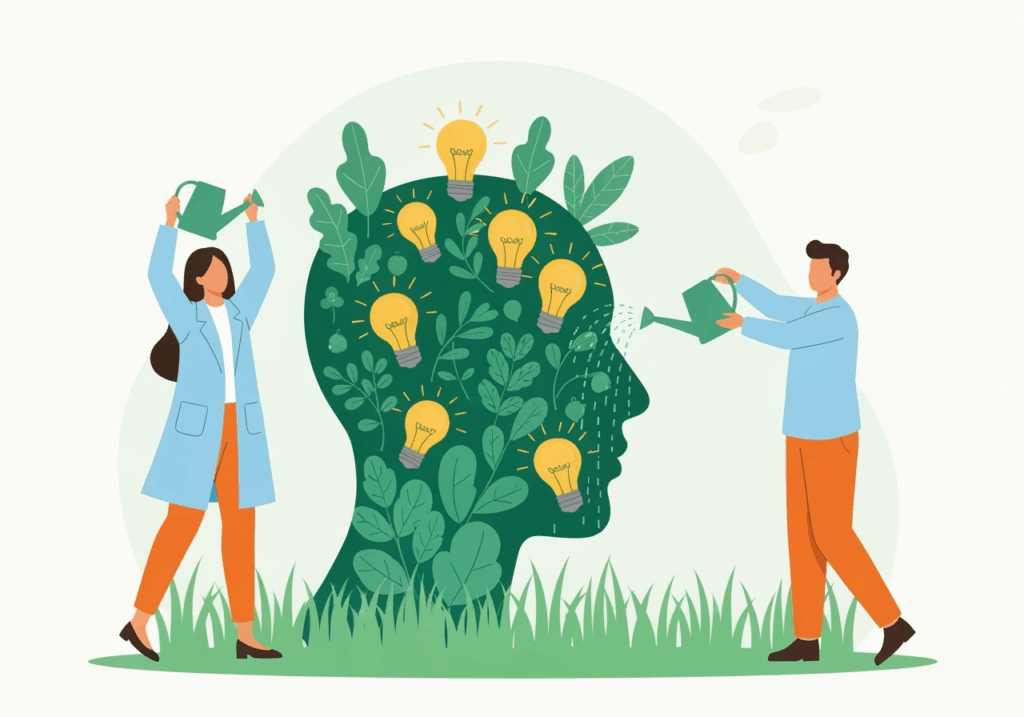
A lot of my work, both one to one and in courses, is concerned with getting people to change their mindset. Our mindset is our outlook on the world, the lens we habitually look through, which is shaped by our prior experience. Our mindsets largely operate outside our conscious awareness, but nevertheless influence how we feel and think in our day to day living and in shaping our values. They influence what we pay attention to, how we interpret situations.
Whether we are trusting or suspicious of others is largely determined by how we were taken care of in our early years. This is true even of animals: my brother has a rescue dog, Sadie, who barks at everybody who comes into the house, and takes a long time to settle. If it is a tall male who wears boots, she may not stop at all and will cower in the corner while barking. It is easy to see Sadie’s mindset in operation, and where it came from.
Confirmation bias can embed unhelpful mindsets
The trouble with mindsets is they may or not be accurate. The vast majority of visitors to my brother’s house, are in fact harmless. In the famous words of the anthropologist, Gregory Bateson, “the map is not the territory”. By a process called confirmation bias, where we are primed to see “evidence “ for existing beliefs and attitudes, we can become locked into mindsets such as self blame, self recrimination, or perhaps the opposite, always projecting blame onto others, which can not only be inaccurate but also psychologically damaging either to ourselves or others around us.
In a sense, the whole process is not unlike what happens with algorithms on social media. For instance, I love looking at images of animals having fun, and if I watch a full video of this or click on it, pretty soon, if I am not careful, my feed will be full of golden retriever pups falling over each other, pandas frolicking on slides and ropes, or cows galloping out into the fields having spent the winter in a barn!
This is quite harmless, and even beneficial, because of the feel good chemicals released while watching such stuff but there is a darker side to algorithms, where someone with a mindset that people of a certain colour, religion, nationality or gender orientation are inferior or superior to others, will be funnelled into seeing more and more content that confirms their pre-existing bias and may come to regard it as the truth.
This process of confirmation bias embeds our mindsets even deeper, the lens we look through seems like the ‘natural” way of looking at something, the ‘truth”. We may not even be aware that we are looking through a distorted lens.
Mindsets have real life effects
Mindsets matter, because whether we are aware of them or not, they have measurable effects on our physiology and behaviour. Professor Carol Dweck, of Stanford University, discovered the benefits of a growth mindset when it came to learning. She found that children who believed that they would learn from their mistakes and that trying would eventually bring a result, had better academic outcomes than those who had a fixed mindset who believed that their intelligence level determined the result they achieved. Her research started a whole trend in education and child rearing that focused on praising the process, what the child did, and giving feedback based on that, rather than on self-image based praise.
Mindsets influence Health and Longevity
However, it is not only in the field of learning that mindsets are influential. Health, longevity and thriving throughout the lifespan are all related to our mindsets, our beliefs and attitudes, as much as physical and lifestyle variables.
Dr.Becca Levy, of Stanford University, author of Breaking the Age Code did a series of studies comparing those who had a negative mind set towards aging, to those who had a more positive one. She found that people with a positive mind set lived 7.5 years longer and had better health. They were more inclined to take proactive measures such as make lifestyle changes, and have regular medical check ups. Those with a negative mindset towards aging had poorer recovery from injuries, higher incidence of Alzheimer’s, more memory decline, reduced physical function, more stress and psychiatric problems.
In an intriguing study, Alia Crum and Ellen Langer of Harvard University did an intervention, where half of a group of chambermaids, working in different hotels, were shown videos explaining how the tasks they did as part of their daily work counted as exercise, and had beneficial effects on their health. After only four weeks the group who now knew that their work counted as good exercise, showed more weight loss, decrease in blood pressure, lower body fat, BMI and better waist to hip ratio compared to the control group who did not receive this information. And all this without taking up any extra exercise outside of work!
Our mindset to stress can reduce its effects
And even with stress itself, which is often painted as purely negative, it has been found that groups who were shown videos on how it could be beneficial showed lower stress responses, even in situations where acute stress (getting people do presentations which were judged by their peers) was induced (Alia Crum, Peter Salovey and Shawn Achor).
More recently, Crum’s team at the Stanford Mind & Body Lab did a large scale study during the recent Covid 19 crisis, where they educated participants to develop a growth mindset, to see the crisis as having some enhancing benefits. The aim was not to develop a blind positivity, but after watching the videos, they asked participants to reflect and write on possible growth they experienced as a result of living through the pandemic. Those who received the intervention showed lower levels of depression and lower levels of inflammatory markers linked to chronic stress and disease.
We can change our mindsets
Mindsets are learned behaviour, and in theory, anything that is learned, can be unlearned. Some really deep core beliefs embedded as a result of trauma can be more difficult to re wire. Sadie, for instance still barks at strangers, even though she has not met abusive people in the last seven years. Similarly, survivors of abuse, those with PTSD may require more individual work.
Having said that, the vast majority of mindsets are very malleable. This is good news as our mindsets have such profound effects on our health and wellbeing. For instance, research shows that happy people have as many setbacks as the more anxious or depressed. The difference is, they don’t dwell on the setbacks, they don’t keep re-running the bad stuff in their heads.
Change your own algorithm: shift your focus
What matters is what we focus on. Focus on the good content, change your own algorithm. We do not deny that there are disappointments or setbacks, but we are going to be the architects of our mental content. Focusing on the good, expressing gratitude for our blessings, re-running good experiences as opposed to re-running bad ones, changes our mindset and predisposes us to interpret ourselves and the world around us in a more positive way.
REFERENCES
Dweck, Carol Mindset-Updated Edition: Changing the way you think to fulfil your potential publ Robinson 2017
Levy, Becca Breaking the Age Code publ Ebury 2022
Crum, Alia J, Langer Ellen J, Harvard University Mind-set Matters-Exercise and the Placebo Effect publ Psuchological Science 2007 Feb 18(2) 165-171
Crum, Alia J, Salovey, Peter Yale University ,Achor , Shawn Good Think, Cambridge Massachuetts
Rethinking Stress: The Role of Mindsets in Determining the Stress Response J Pers Soc Psychol. 2013 Apr;104(4):716-33. doi: 10.1037/a0031201. Epub 2013 Feb 25. PMID: 23437923.
Kinderman P, Schwannauer M, Pontin E, Tai S (2013) Psychological Processes Mediate the Impact of Familial Risk, Social Circumstances and Life Events on Mental Health. PLoS ONE 8(10): e76564. https://doi.org/10.1371/journal.pone.0076564 A brief summary of findings ://www.medicaldaily.com/stop-overthinking-negative-experiences-excessive-rumination-linked-depression-anxiety-260221